NorseSpotting in ... Blade Runner?!?
The Blade Runner franchise is so artfully loaded with questions of artificial thralldom, corporate jarls' overpowering societal influences, the disturbing tropes of Odinically sacrificed eyes, and the framing of saga-like outlawry stories that NorsePlay can't help but verbally blood eagle that human & replicant skin back to lens Blade Runner's dystopian world through the Norse Lore.

As per the some of the cinematic NorseSpotting articles, let's break this down by its elements:


Sacrificing an Eye: Both films open with an extreme closeup of an eye reflecting a mad prophetic warning of a ruined post-eco-Ragnarök world. Eyepatched Freysa in the BR2039 comic & BR2049 film, and eyepatched Iggy in Black Out 2022 are obvious, giving up their serial-marked right eye. Tyrell for his underestimation of his creations loses both his visionary eyes along with his life. Niander also loses both his eyes during a patricidal takeover attempt during the BR: Black Lotus animated series, but later cybernetically gains multiple floating eyes, so like Odin, his sacrifice allows him greater perspective with less actual biological sight. Officer K only requires saving Sapper's serialized eye to scan it into his Spinner's armrest's digital cyberwell to get his payday.
The Inescapable Fate: Nexus 6s only get four years. There's a compressed mortality happening that only amplifies the idea of certain doom and what you can deed within that time. Tyrell praises Baty with: "And you have burned so very, very brightly, Roy. Look at you. [...] Revel in your time." This goads Roy toward what might be considered his glorious end by besting Deckard and having the most memorable last words.
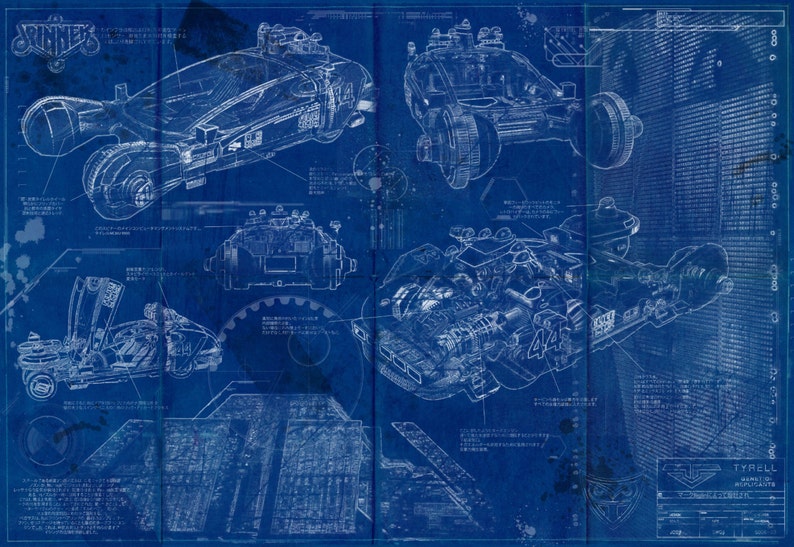 |
| [Spinner blueprint from Biglin Graphics.] |
Spinner Drones As Surveillance Ravens: Popping out from roof above the thrones in BR2049's spinners are built in drones that scan, scout, and record their observations just as Odin's Huginn analyses thought and Muninn stores memory.
The Wooden Horse: Like found Viking toys, it would seems Dr. Ana Stelline's childhood toy pretty much resembles Viking Age (and earlier toy finds [i.e. Vogelherd Horse]), and incidentally could be a blank for a Dalarna Horse. Deckard, whose name is Germanic probably meaning roofer, which both shoos-in to the toy's rather simple workmanlike style and his carving it.

The Nine Worlds: In BR2049, we get a world colony count from Niander that's specifically nine, mirroring the Norse Níu Heimar.

The Potential Fertility of Ginnungagap: Niander likens the vacuum of space to his newborn Nexus 9's infertile & empty womb, and his goal is to fill that space and its nine worlds with replicants who can self-reproduce, much as the abiogenesis of Ymir fills Ginnungagap with the non-godly/non-human jötnar.
Genetic Rune Codes: There's this pointed scene where Officer K and Joi are scanning through gobs of raw birth record data, and trade flirty comments on how DNA creates replicants like him, while zeros & ones make AI like her. The recombination of four letters to represent DNA's nucleotides, and in the machine world, binary sequences as the data to run programs, seems to mirror the power of the Ljóðatal, Odin's spells to sequence the runes so he can perform magic. ATCG = ᚨᛏᚲᚷ, 0101 = [well, the pentadic numeral stave symbols that were used in Scandinavia, but I can't find an actual font with that option, so go make one if you need to runecode up a Joi for us!]
Replicants as Thralls: In the Rígsþula, Heimdallr fathers and assigns the classes of humanity, making a son literally named Thrall with his descendants fated to be servants. Also in Hárbarðsljóð there's an idea of thralls going to Thor's Hall and not being accepted at Odin's. The idea of these created separate orders is a prevalent social & legal structure in both the Old Norse world and the BR world. The Sagas do have stories of thralls who do gain/win/are given freedom, so it's not a permanent status, compared to the replicant condition of being designed for servitude yet still wanting of that same freedom.

Outlaw Replicants: As per the legalities mentioned above, runaway thralls are immediately classed as outlaws and hunted down to be killed, which happens in both the Sagas and in BR.

Dead Yggdrasil: The World Tree, always challenged by continual injuries from many who live upon it, has died in the pollution-ruined world of BR and is presented as Sapper's Tree. There's a pointed conversation between Mariette & K when she says she's never even seen a tree, and later when Doc Badger offers K a real horse in trade for his toy horse just because it is made of real wood, is a huge tell to that material's rarity.
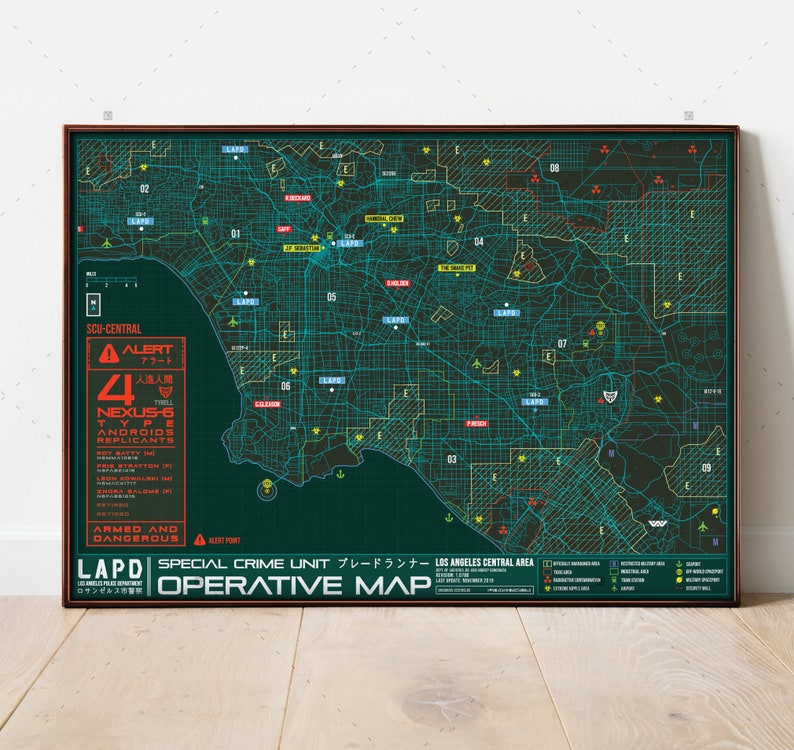 |
| [LA 2019 map designed by Kris Ardrey.] |
The Sea-Wall of Los Asgardr: In the BR comics, the construction of the sea wall is of course accomplished by replicants, not the humans it later protects. This reflects the Æsir commissioning the non-Æsir Master-Builder to make their defensive wall but decide to not pay him for his labor as the asking cost is far too high. It could be seen that the replicants who want the same sun, moon, and love their creators have are not to be shared these for their constructive efforts. (Side note: I'm in no way saying the Æsir could ever have handed over Sunna, Mani, & Freyja, but they also could've not listened to Loki.)
The Lineage of Húskarls Deckard and K: Both of these characters at certain moments suddenly have to call into question their worth that depends on their origin, human or replicant. Neither is confident about who they are, or in their service to LAPD, but both are creatures of oathed duty, which they honor to a fault -- a fault that they eventually externally recognize and must honorably turn outlaw from.
Rachael the Norn: Rachael's the replicant created to give birth, but is fated to die doing it, buried under the Yggdrasil-analogue tree. Norn Verðandi corresponds to the mother who gives birth to the present in the maiden-mother-matriarch triumvirate. Niander's offering of Rachael 2.0 could be viewed as Skuld (her name actually meaning "debt"), the Norn who delivers the future, but Deckard both rejects the offered indebtedness and a future with Rachael 2.0.
Trǫll Sapper: Living in the outlands to farm huge white grubs and grow garlic on the side, Sapper lives a life of isolation, wearing a dehumanizing protective suit while harvesting in artificial cavernous half-tunnels. It could be argued that like the treasure rich denizens of the underground that in these trollish caves Sapper is surrounded by the wealth of food and, outside of these, the luxury of space, things which most of the LA human populace struggles daily to acquire. His hulking combat model trollish appearance also sets him apart from humanity far more than other replicants.
J.F. Sebastian the Dwarf: Designer/Crafter of the replicants' nervous system, Sebastian's essentially a magical forge-master for the deity-like creator Tyrell, very much like The Sons of Ivaldi or Brokkr & Sindri making the contest gifts for the Gods. His diminutive animate toys, the kaiser Squeaker Hussar and teddy bear Colonel Fuzzy also are made to match his dwarven scale brought on by his Methuselah Syndrome that gives him his non-human appearance.
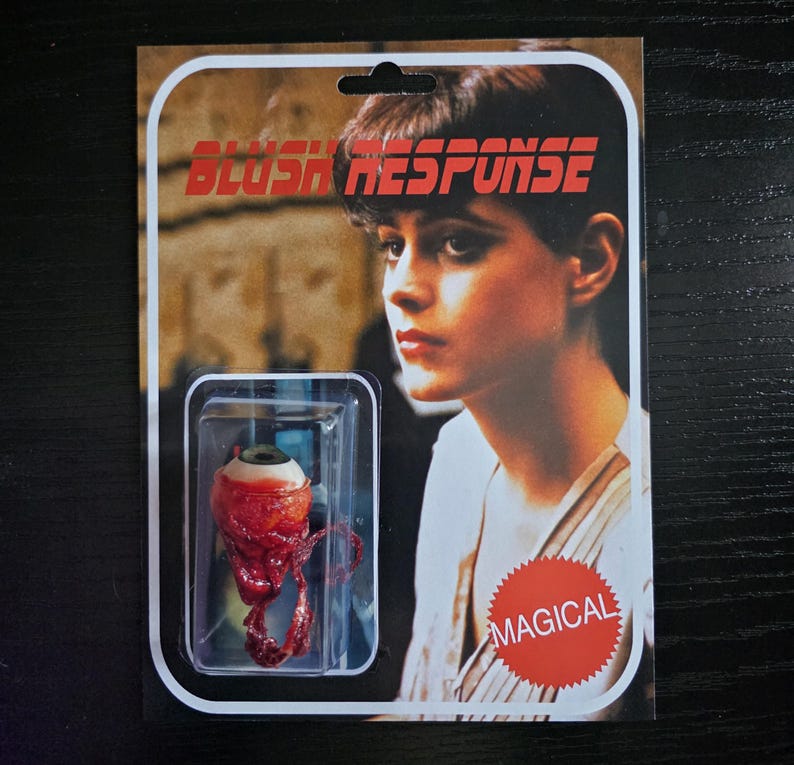 |
| [custom carded eye accessory made by MagicalToyCompany.] |
Hannibal Chew as Mímir: In his frosty cave of a store, the geneticist who creates the eyes for the Nexus 6s has tables topped with little storage wells full of eyes. It is Baty and Jötunn/Trǫll Leon who visit him that are able to reverse the eye-into-well sacrifice by pulling them out of their cryonic fluids, with Leon placing them on Chew's shoulders in a playfully threatening way. Chew is then compelled to offer information on their quest to get to into Tyrell's Asgardr. Their stripping of his heating tube jacket to do so could be seen as the disembodiment of Mímir.
Pris as Freyja: Offered up in the film as the ideal pleasure model, woofully confident in her beauty, but also strong and deadly, qualities of the idealized Freyja who is an equally confident Goddess of Love & War.


Zhora the Snake-Witch: Working at a strip burlesque bar called The Snake Pit, Zhora does a ritualistically billed erotic stage act with a synthetic snake, adorns herself with glittering accent scales, and has a snake tattoo. If there's a parallel to be found, it's in the explicitly splayed snake-witch figure manipulating two snakes on the Swedish Snake-Witch picturestone from 400–600 CE. Zhora was described as being part of a "kick murder squad" so the idea of a harmful serpent as a totemic familiar rather fits as all the serpent references in the Norse Lore are not positive ones.
 |
| [Rutger Hauer as The Last Kingdom's Ravn next to his Roy Batty.] |
Batty as Úlfhéðinn-Poet: The wild wolf-warrior howl, galactic war veteran, knowing the genetic runes in his knowledge testing/seeking dialogue with Tyrell, using various poetic literary quotes throughout the film, and especially his amazing death song monologue of the same caliber as Ragnar's Krákumál or Arrow-Odd's Ævioddr or Hjalmar's dying farewell to his intended Princess Ingeborg.
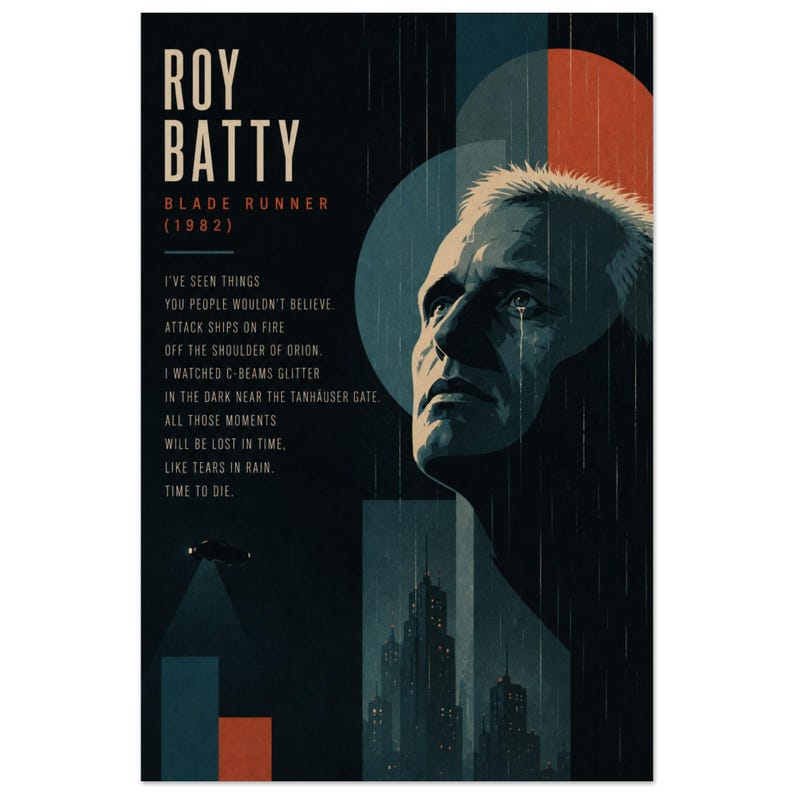 |
| [from CDRMinimalistPosters via Etsy.] |
Ana Stelline the Dream-Völva: In the lore and sagas there's quite a bit of dream sequencing & interpretation that foreshadows how events are going to unfold. In imbuing replicants with created memories, this manufactured emotional experience determines how they will not only cope but react, which Ana claims responsibility for to K. Her device could passingly be the euqivalent of a magic weaving distaff wand and its spindle whorl dials in how it turns to generate visions that form the threads of who replicants are, made not with real memories, but with the ones she's dream-woven up for them.

While putting all the above together, I actually managed to get a question forwarded via a friend⸸ to BR screenwriter Hampton Fancher to directly ask if BR took any conscious inspiration from the Norse Lore, but the relayed reply was:
"Hampton tells me that Norse Mythology was not on his mind when working on the Blade Runner Films. Not at all. Though he said he suspects Phillip K. Dick may have been interested in it."After doing a cursory look based on this response's lead, it appears PKD was a theologically obsessed syncretist, so he used alot of religious comparatives that actually included Norse concepts like Odin's Bolverk aspect and Ragnarök as part of his larger works in Valis and The Exegesis. While both of these postdate DADoES, the amassing of those two books (Exegesis was an 8,000 page manifesto [!] edited down to still hefty 900 pages) could imply that the ideas were likely already percolating in PKD before DADoES. There's also the added possibility that co-screenwriters David Peoples on the first film or Michael Green on its sequel may have put some of the above up in the mix. Whether by intended subtext or subconscious incident, there could be some of PKD and/or other screenwriters' Norse knowledge presenting itself. And while I don't want to get into DADoES (and honestly, BR's one of those cinematic exceptions that farrrrrr outstrips its source material) here's one more thing:
Rooftop Bovidae: The book's Deckard keeps an electric sheep on the roof as a status symbol, while in the Lore there's Heiðrún, a she-goat that lives on top of Valhalla whose udders provide endless mead for the hall's einherjar, the ultimate warriors of status.
So even if you feel NorsePlay is stretching here (though the above is stacked pretty high with potential influences), at the very least one can see that the Norse Lore's archetypes could serve as backward compatible atavistic DNA for BRs characters, settings, and framing, if not a divine manifestation peeking through the narrative that might explain why Blade Runner has endured for so long and continues to do so.
And in case there ever were an Old Norse dub (please, someone NorsePlay this), the title would be Brandhlaupari and replicants are Endurgerðarmaðr, literally "re-created man". (And yeah, I NorsePlay'd that logo, and you bet there's gonna be a t-shirt design using that.)
[I would like to credit a reddit thread started by user tomchristie for initial observations that I've springboarded & developed off of.]
Guillermo Maytorena IV knew there was something special in the Norse Lore when he picked up a copy of the d'Aulaires' Norse Gods and Giants at age seven. Since then he's been fascinated by the truthful potency of Norse Mythology, passionately read & studied, embraced Ásatrú, launched the Map of Midgard project, and spearheaded the neologism/brand NorsePlay. If you have employment/opportunities in investigative mythology, field research, or product development to offer, do contact him.


Comments
Post a Comment