Posts

Showing posts with the label Helga þáttr Þórissonar

drink up with Byggvir & Beyla.

Image
In the Norse Lore there appears paired legendary drinking horns like the Whitings and Godmund's Golden Horns from Helga þáttr Þórissonar , or within archaeology like the Golden Horns of Gallehus, or the Early Anglo-Saxon ones at The British Museum, or these pictured Sutton Hoo horns. This raises the question of why two separate horns are needed. While the more obvious answer is that horns naturally come in pairs off the heads of bovines so why not keep them paired, yet more pragmatically unless you're double fisting it then you only need one at any given moment of drinking for your single mouth. My previous reading of Georges Dumézil gives us the rather well-fitting theory that Freyr's servants Byggvir & Beyla are poetically named for Barley & Bee , both associated with Freyr's agricultural harvest of plenty. Within The Pre-Christian Religions of the North V.3 (ch54, p1410, Lindow & Schjødt), we're presented with a picture of a pair of preserved drinki...
NorsePlay Investigates: The Giants Grim & Godmund's Golden Horns!

Image
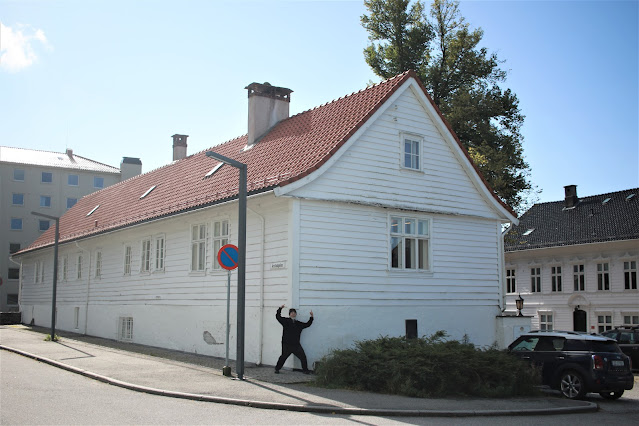
While in Norway's Bergen, during my recent cross-Atlantic trip, I went to investigate the Map Of Midgard sites of The Giants Grim & Godmund's Golden Horns: Above's the current day Alrekstad Skole, the site where Álreksstaðir, King Olaf Tryggvason's residence, once stood. Odds are this long building probably sits squarely where the royal hall used to be, so it's easy to imagine it being there. The story of the Giants' Grim & Godmund's Golden Horns from Helga þáttr  þ órissonar tells of two giants both named Grim entering Olaf's hall bearing the gift of a pair of golden drinking horns from their Jötunn King Godmund. Olaf has the giants served, and being the hardcore convert that he is, blesses their drinks. The giants, being Heathen supernatural creatures, find they now cannot drink them, and are angered at this seeming turn of backhanded hospitality. They cast darkness in the hall, kill three of his men, and leave via a mountain pass, which beca...