drink up with Byggvir & Beyla.
In the Norse Lore there appears paired legendary drinking horns like the Whitings and Godmund's Golden Horns from Helga þáttr Þórissonar, or within archaeology like the Golden Horns of Gallehus, or the Early Anglo-Saxon ones at The British Museum, or these pictured Sutton Hoo horns.

This raises the question of why two separate horns are needed. While the more obvious answer is that horns naturally come in pairs off the heads of bovines so why not keep them paired, yet more pragmatically unless you're double fisting it then you only need one at any given moment of drinking for your single mouth.
My previous reading of Georges Dumézil gives us the rather well-fitting theory that Freyr's servants Byggvir & Beyla are poetically named for Barley & Bee, both associated with Freyr's agricultural harvest of plenty.
Within The Pre-Christian Religions of the North V.3 (ch54, p1410, Lindow & Schjødt), we're presented with a picture of a pair of preserved drinking horns (fig 54.1) captioned that this find from Söderby-Karl after analysis determined that one horn was used for beer while the other was used for mead. This separate exclusivity of purpose might be the answer that the pairing of horns, each with its dedicated drink, represents Byggvir for his Barley's use in beer, and Beyla for her Bee honey's use in mead. Whether or not the vessels being used for separate beverages is just lunch cafeteria tray style compartmentalization could be argued, but also the idea that these decorated & prestigious sets had a ritual purpose that recognized Freyr's gifts and the figures of Byggvir & Beyla has the NorsePlay ring of structural truth to it, so maybe its time to start shopping for that second horn.
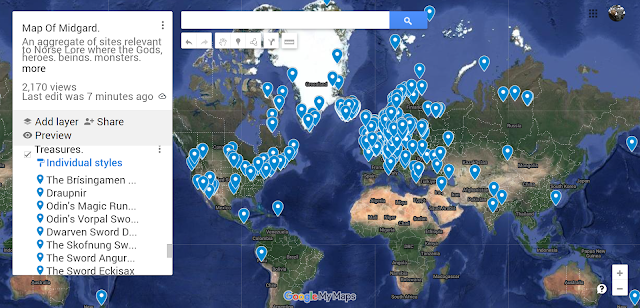
Guillermo Maytorena IV knew there was something special in the Norse Lore when he picked up a copy of the d'Aulaires' Norse Gods and Giants at age seven. Since then he's been fascinated by the truthful potency of Norse Mythology, passionately read & studied, embraced Ásatrú, launched the Map of Midgard project, and spearheaded the neologism/brand NorsePlay. If you have employment/opportunities in investigative mythology, field research, or product development to offer, do contact him.


Comments
Post a Comment