NorsePlay Investigates: The Bisbee Runestone!
A friend who frequents the charmingly small but vibrant historical city of Bisbee, AZ, USA, spotted this very random runestone perched in front of a house:

My friend was also good enough to leave my card & a note of inquiry at the house whose sidewalk this happens to be on and I was contacted by Ben, the property owner, who was kind enough to tell me what he happened to know about it, the information which I've integrated into the following investigation.
[Note that I'm only working from two photos my friend took, and the by-text interview that Ben, it's current owner, gave me. At some point I know I'll be back in Bisbee and have a firsthand look at it myself, but felt it was more important to report this curiosity secondhand in a timely manner rather than wait on an indeterminate future road trip.]
Ben reports that it's a granite stone weighing "300 pounds" at ~26" tall with a ~13" diameter.

The above photo shows three Elder Futhark hand-chiseled rune rows executed pretty straight around the front curved surface. Not including the word separator dots, there's 43 characters total discernable from the photo.
Subjective Observations:
Normally most accepted orthodox runestones are on far broader and taller slabs of stone to serve as visually impactful memorials or property markers or both. The late unorthodox (and highly contested) Kensington Runestone is only 30"x16"x6", so that would make the Bisbee Runestone of this American scale of runestone, if we decided to create a category for that (though the Heavener Runestone in Oklahoma's old world scale by contrast).
Let's get to the Runes themselves. So most contemporary rune use is Elder Futhark just transliterated letter for letter from English, which according to my work below, it would seem to be. From the context that Bisbee is an artisan town with alot of sidewalk signage for shops to attract customers, this is what I felt it very roughly translated to:
 |
For Thine Business Open Explore Within Guests Please |
Yet Ben's account of the stone, which he heard from his neighbor, indicates something different:
"A woman and her son lived in my place in the '90s. Her son took up a hobby in Gaelic writing, [and] he & his friends hauled the stone there and he chiseled the inscription. [...] 'Whomever can lift this stone may keep it'. Supposedly [it] was a [joke]. [...] The stone has had many speculate over the years and is a true [Brewery] Gulch anomaly."
Given the extreme weight of the stone, and Ben's account that it took 3 or 4 people to move it, and if we are to believe his neighbor's version of the inscription, this is what's actually known as a "lifting stone."
There are hundreds of lifting stones globally, and many Icelandic ones of note. Grettir's Saga specifically mentions his namesake Grettistak stones that the famous outlaw lifts as an amazing proof of strength. Temporally forward of that, we can still see people attempting such lifts with Iceland's historic stones today, this following example being of the 410-pound Húsafell Stone:
Conclusion:
This is a modern runestone, and whether it's a clever shop sign, or a taunting test of strength, it is great to see the runestone tradition revived in my Arizona.
[photo & outreach credits to my awesome friend Bill Dennis! So normally there's GPS points for the "NorsePlay Investigates" entries at the end, but Ben has requested we respect his privacy, and that if you do happen upon the Bisbee Runestone, you do NOT have permission to lift it, so don't even think about it!]
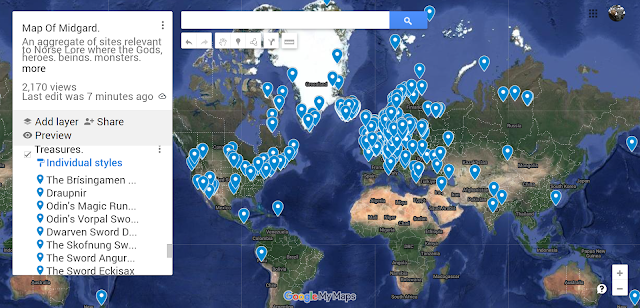
Guillermo Maytorena IV knew there was something special in the Norse Lore when he picked up a copy of the d'Aulaires' Norse Gods and Giants at age seven. Since then he's been fascinated by the truthful potency of Norse Mythology, passionately read & studied, embraced Ásatrú, launched the Map of Midgard project, and spearheaded the neologism/brand NorsePlay. If you have employment/opportunities in investigative mythology, field research, or product development to offer, do contact him.


Comments
Post a Comment