NorsePlay adds a "runestone" to its yard Vé.
After the city & cable company decided to totally spraypaint mark underground lines in my easement area and front yard (which is where I have my holy Vé with the sacred tree I leave offerings in front of), I decided to then spraypaint & adorn their semi-eyesore broadband podium box that's stood unused in my Vé since I bought the house well over a decade ago into a runestone of my own:

Semi-modeled after the Karlevi Runestone (Rundata Öl 1) on the island of Öland, Sweden, my "runestone" like most has been "raised" as a property marker, a praise/boast of achievement, and in memory of one who's died/fallen. Bouncing my text through Valhyr's Old Norse translator, I then used their Short Twig Futhark converter on the ON for the following (with a bit of transliteration to keep proper names intact):
These Runes are drawn by
Guillermo Skald of NorsePlay
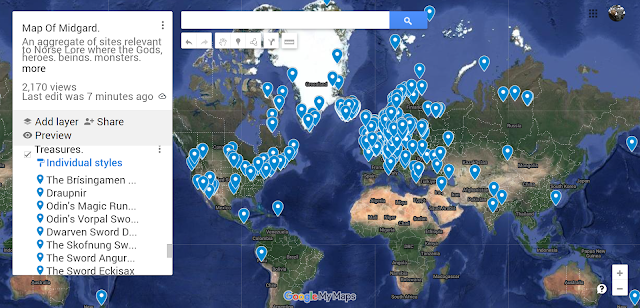
Mapmaker of Midgard
Owner of this Vé and Red Hof
And Raised in Memory Of
Buddy Guillermosson
For a parallel bit of Tucson context, in the Southwest there's a fair amount of amazing Mexican Catholic yard decor (i.e. bathtub Virgen de Guadalupe shrines), and, as with any religious/cultural regionalism, those traditions can be loaned & borrowed as we've seen in the past (i.e. Celts, Sámi, etc). And as a Hispanic Asatruar, I'm open to cross-pollination that can successfully amplify our praxis & aesthetics with respect. While the one tree on my property just happened to be in the front yard (and thus by default became the offering place), grave mounds and runestones tended to be by boundaries where passerbys would see them, so anyone now walking my street can't help but notice my new addition in bepuzzled wonderment.
And now you're asking, "But Guillermo, how exactly do I NorsePlay something like this for myself?" So here's the easy to follow visual step-by-step breakdown:
 |
| [see all those paint lines & cable flags? Grrrrrr!] |
Above is your city's front yard eyesore podium box. Clear the dirt & tree sheddings from around the base as best you can, clean the surface with a nearby hose & brush, and #220 sandpaper the surface to rough it up enough so the paint will stick.
Then hit it with half a can of Rust-Oleum 2X Ultra Cover Paint + Primer, judiciously pausing about 15 minutes between coats, and you'll get the clean & ready surface you see below:


 |
| [this very special Borre pattern engraved shot glass has its own story, and felt super-right to use for this endeavour as a palette cup. Note that for the six lines of text this turned out to be four times too much paint, so pour accordingly.] |

 |
| [with my personal Elder Futhark bindrune of Gebo & Mannaz on the crown to top it off!] |
After letting your inscriptions dry indoors for the night, put it back out and hit it the next day with half-a-can of Krylon UV-Resistant Clear as a multi-layered protective topcoat. You need this as the stone specialty paint isn't actually an outdoor paint, and the acrylic is subject to long-term fading, so this should preserve all your previous efforts, and finish the job right! This clear wasn't a dulling matte nor a glossy candy coat glass topping -- it layered down really invisibly, so big recommends on finding this specific spraycan.
The final result in situ:
 |
| [note the Yule shoe with now-old carrots for Sleipnir against the tree, and the hörgr at its foot for faining.] |
Guillermo Maytorena IV knew there was something special in the Norse Lore when he picked up a copy of the d'Aulaires' Norse Gods and Giants at age seven. Since then he's been fascinated by the truthful potency of Norse Mythology, passionately read & studied, embraced Ásatrú, launched the Map of Midgard project, and spearheaded the neologism/brand NorsePlay. If you have employment/opportunities in investigative mythology, field research, or product development to offer, do contact him.


Comments
Post a Comment