Posts

a NorsePlay on words.

Image
We've all heard the Loki/Low-Key one, but then my genius-level polymath pal Matt decided to declare a state of "Ymirgency" in this Thanksgiving day group text that really caught me off guard. (And yes, my friends are actually awesome enough to indulge my love of the Norse Lore like this.) If we look at Ymir's name , it gets variously translated as sound/utterance/to cry/whine, which could very well make it a "Ymirgency" ambulance siren of sorts. And odds are he made his share of cosmic-level wailing during his dispatching  by Óðinn, Vili, & Vé. With all the kennings, deadpanning, implications, entendre, & grim humour in the Sagas , punning itself seems to not be so much of a common convention, but given the use of all these other clever names and literary structures we should start NorsePlaying them into our retellings & original compositions as it can only add to the skaldic toolbox and enrich the spirit of the Lore. Ergo: Feeling a little Tý...

then I finished reading The Complete Sagas of Icelanders!

Image
After 2,260 pages, I've unlocked the achievement of reading all five volumes of The Complete Sagas of Icelanders ! I cannot pass judgment or literary review on the Sagas as a whole. † There's just too much, and the corpus itself is too important historically to come at it as though one had just read a novel or non-fiction book. What I will do instead is (in very brief) tell you the main facets & merits of reading saga literature if you're so much of a hardcore NorsePlayer as to be compelled to read them all. Like Snorri Sturluson 's Heimskringla 's dominant historical pattern of acquisition, conflict, kingship, there's a general interpersonal narrative pattern that emerges with many of the sagas: offence, retribution, vengeance, resolution. Often feud & vendetta are the operative driving forces between these Settlement Era Icelanders' stories, which quickly amplify past whose sheep trespass to graze on another's land and escalate into the socie...

NorsePlay Investigates: The Stone Of The Hidden Man!

Image
During a far too short stop of my recent cross-Atlantic trip in Reykjavik, I went to investigate the Map Of Midgard site of The Stone Of The Hidden Man! Tucked behind a strip of shops at 32 Ármúli Street is an elf stone, the Huldumannssteinn (literally "Hidden Man Stone"). This stone was originally bigger and partly demolished, but this large portion was left. The then-owner was visited in a dream by its resident alfar, who asked him to leave his remaining home alone or else bad luck & misfortune would come of it, so he did. [Looking through the split.] According to Terry Gunnell's The Hidden People of Iceland (2008 CE), some bakers later bought this property to open a chicken farm whose chickens wouldn't lay once they bore holes into the remaining stone for demolition. When they figured out this cause, they spared the rock and the chickens resumed laying eggs again the next day. My cabbie, a Reykjavik Icelander for over 30 years, said he had no idea that this ...

signs of the Futhark?

Image
  These  interesting Futhark rune signs over need-fire NorsePlay'd graphic arrived in a promotional email sent out by Magin Rose. I honestly don't know enough about sign language to know if the Þ sign is correct, or if this is partly taken from the (questionable/inventive) "runic mudras" of Edred Thorsson, or partly from Joanne Harris' Rune series of books, or from the unattributed chart found on the internet below, but I like the visual aesthetics of this, and wonder again if the Norse had established themselves for the longterm across the Atlantic if this might've become their Vinland Sign Language. #    #    # Guillermo Maytorena IV knew there was something special in  the Norse Lore when he picked up a copy of the d'Aulaires'  Norse Gods and Giants  at age seven. Since t hen he's been fascinated by the truthful potency of Norse Mythology, passionately read & studied, embraced Ásatrú, launched the  Map of Midgard  project...

NorsePlay Investigates: The Giants Grim & Godmund's Golden Horns!

Image
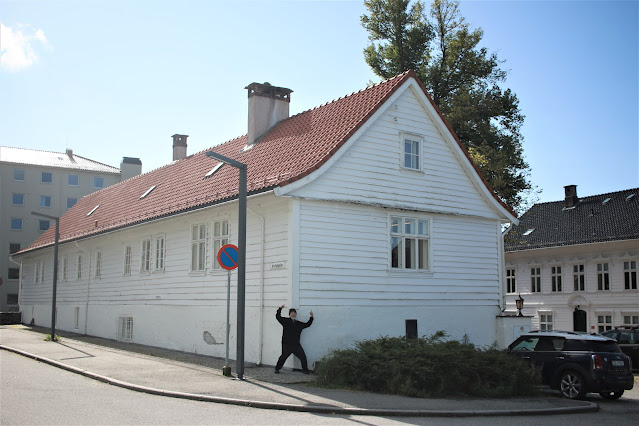
While in Norway's Bergen, during my recent cross-Atlantic trip, I went to investigate the Map Of Midgard sites of The Giants Grim & Godmund's Golden Horns: Above's the current day Alrekstad Skole, the site where Álreksstaðir, King Olaf Tryggvason's residence, once stood. Odds are this long building probably sits squarely where the royal hall used to be, so it's easy to imagine it being there. The story of the Giants' Grim & Godmund's Golden Horns from Helga þáttr  þ órissonar tells of two giants both named Grim entering Olaf's hall bearing the gift of a pair of golden drinking horns from their Jötunn King Godmund. Olaf has the giants served, and being the hardcore convert that he is, blesses their drinks. The giants, being Heathen supernatural creatures, find they now cannot drink them, and are angered at this seeming turn of backhanded hospitality. They cast darkness in the hall, kill three of his men, and leave via a mountain pass, which beca...

Map Of Midgard side update: The Path of Odin map now available at Nexus Books!

Image
During the current ongoing backup & editing process for The Map Of Midgard , I took a four-month departure to produce a proof-of-concept Odin-specific map, the  Óðinnsvegr : The Path Of Odin map , which is now for sale at Nexus Books in Tucson! Prints are $25 USD each, and a glass & wood framed version is $75 USD. Note that in under 24-hours, the first batch of map prints have sold, and I've had to go restock them already! You may also contact me directly for purchase, and I also have plans to have them retailed at a few other venues in Tucson, and will announce that here as it happens. Note that  map purchase includes Gmail account access to the digital map with rollover story/source data and GPS coordinates!  For example: About the  Óðinnsvegr : Using the 54-Odinic mappoints from the larger Map Of Midgard , I commissioned Medieval Mapmaker Jesse Kennedy, an artist who has extensive experience in hand drawing hundreds of map designs. I'd met him y...

possessing the head of Mímir.

Image
This grave find from Aska, Hagebyhöga, Östergötland, Sweden, was mentioned in a recent video by Dr. Irina-Maria Manea as being thought by some to be the head of Mímir! If so, the specific design of this silver head pendant measuring about 2x2x3 centimeters provokes further thought. To NorsePlay: Knotted Mouth: The pretzel of Mímir's mouth might indicate difficulty in getting the dead jötunn to talk. Clawed Head: The bird crowning  Mímir and literally digging claws into his temples might be the device that compels him to speak. Huginn & Muninn: If the bird is literally the either/both the ravens of Thought & Memory, then it would be functionally appropriate that they are extracting their namesake mental information from  Mímir. While all the methods of this necromancy may seem cruel, you should remember that  Mímir could easily just given his own nephew a drink from his Well Of Wisdom but instead stingily demanded Odin sacrifice an eye,...

NorsePlay Investigates: the Hulder Rock!

Image
After starting the Map Of Midgard Project, I took note when Viking Metal band Týr's lead singer Heri Joensen mentioned an Álfar rock in his Faroe Islands' childhood home during an interview, and I personally made an investigative foray to go see it during my recent Scandinavian cross-Atlantic trip. According to Joensen, at fishing village Lamba's harborside on Eysturoy,  sits a rock inhabited by hulderfolk which no one dares move for fear of fierce retribution. The cabbie had never heard of the rock, and stopped a senior Lamba resident out on his afternoon walk to ask and check my story. The sock beanied man in the insulated track suit nodded & pointed down the road, confirming that we were headed in the right direction. At road's end a private property sign on chainlink fence blocked off the dock where the stone was, but the cabbie asked a forklift operator moving a huge tub of fish if we could go in to have a look, and he said yes while laughing a little, which ...

NorsePlay Reviews: Borges' Ancient Germanic Literatures.

Image
Discovering that celebrated Argentinian author, librarian, & intellectual Jorge Luis Borges wrote a survey called  Ancient Germanic Literatures was like finding a hoard of gold in my backyard, and I finally got to open & read this brief book during my recent Scandinavian cross-Atlantic vacation. As an investigative researcher, avid reader, Hispanic writer, and appreciator of Borges, I was totally enthusiastic to explore his insights into the sources from a Latin perspective I could personally identify with. Borges' masterful surrealism & erudition is pretty much second to none, so to turn that brilliant spotlight of his mind upon the deep dark wells of Norse source texts was such an exciting prospect. Yet, not to criticize the Master, my essay & short fiction-bred high expectations of Borges were actually far beyond what his intention was , and the fault in doing that is solely mine.  When writing  Ancient Germanic Literatures  back i...

the nail-ship of the dead.

Image
  As if the idea of Naglfar, a ship made of the nail clippings of Helheim's dead, sent against the Einherjar at Ragnarök isn't an unsettling image enough, this Russian-style depiction makes one wonder what if the Kyivan Rus' had never converted, and what that artistic tradition might've looked like. The other interestingly NorsePlay'd visual choice here is that the dead seem to be the giants compared to the scale of the opposing drakkar below, which raises the question of what happens in the long run when Thor & the other Aesir take out their jötnar enemies if they're only going face them again in the host of the dead when the end battle comes around. [From Boris Zaborikhin' illustrations to The Elder Edda .] #    #    # Guillermo Maytorena IV knew there was something special in  the Norse Lore when he picked up a copy of the d'Aulaires'  Norse Gods and Giants  at age seven. Since t hen he's been fascinated by the truthful potency of Nors...

save the Nine Worlds ... at least for more than yourself.

Image
  Loki: Whattajerkface! In this 1985 CE issue of Thor #353  distinctively   drawn by Walter Simonson , here is laid the device by which Thor: Ragnarok hangs: Marvel Surtur needing to dip his world-burning sword Twilight into the Eternal Flame in order to fulfill the Volva's prophecy of his destiny as the agent which destroys the Nine Worlds. This comic panel has the trio of Gods teaming up to prevent that. And sure, Loki's selfish honesty's amusing by contrast, but when we look at the Norse Lore, we see a God who maliciously cuts off Sif's hair , steals Freyja's prized necklace Brisingamen , cravenly makes a deal with an enemy giant to kidnap Iðunn to deny the Æsir their sustaining apples of youth , carelessly underestimates in betting the Sun, Moon, & Freyja to get Asgard's wall built, has an affair that fathers two cosmic monsters that will kill two major Gods, and is ultimately responsible for killing Baldr, which is the temporal trigger for herald...