C.S. Lewis adored Norse Mythology best.
"If Christianity is only a mythology then I find the mythology I believe in is not the one I like best.
I like Greek Mythology much better.
Irish better still.
Norse best of all."
~ C.S. Lewis
The Weight of Glory (1941 CE)
It's heartening to hear such a noted Christian Apologetic praise the Norse Lore. If we examine Narnia, we find elements like The White Queen corresponding to jotun maidens, or the dragon-prowed Dawn Treader matching to the magical saga drakkar longship Elliði, or greedy Eustace Scrubb turning into a dragon just as gold-hoarding dwarven Fafnir turns into a hoard guarding wyrm.
 |
| [of course C.S. Lewis read the Eddas at some point.] |
Far before penning the above, as a kid Lewis read Longfellow's Tegnér's Drapa (the title presumably referencing Esaias Tegnér's version of Frithiof's Saga), and wrote in Surprised By Joy (1955 CE) of the moment the following lines changed him:
I heard a voice that cried,
Is dead, is dead ——
“I knew nothing about Balder; but instantly I was uplifted into huge regions of northern sky, I desired with almost sickening intensity something never to be described (except that it is cold, spacious, severe, pale, and remote) and then, as in the other examples, found myself at the very same moment already falling out of that desire and wishing I were back in it.”
There's been much ink spilled about Odin's son Baldr's death & return from Hel being analogous to Jesus' resurrection, and surely young Lewis must have seen that pre-Christian relation as part of this personal revelation when he did investigate Baldr. Soon after Lewis ran across an Arthur Rackham illustration for Wagner's Ring Cycle, and was again swept into an Odinic ecstasy:
In the Norse Lore, sibling children Þjálfi & Röskva pass into otherworldy Jotunheimr with Thor & Loki, and a reader now has to wonder at the throughline from the Pevensies passing through a wardrobe into a befrosted Narnia to fulfill fateful encounters alongside Aslan, and the idea of The Last Battle paralleling that of Ragnarök. NorsePlay on, Lewis!
“Pure ‘Northernness’ engulfed me: a vision of huge, clear spaces hanging above the Atlantic in the endless twilight of Northern summer, remoteness, severity … and almost at the same moment I knew that I had met this before, long, long ago (it hardly seems longer now) in Tegner’s Drapa, that Siegfried (whatever it might be) belonged to the same world as Balder and the sunward-sailing cranes. And with that plunge back into my own past there arose at once, almost like heartbreak, the memory of Joy itself, the knowledge that I had once had what I had now lacked for years, that I was returning at last from exile and desert lands to my own country; and the distance of the Twilight of the Gods and the distance of my own past Joy, both unattainable, flowed together into a single, unendurable sense of desire and loss, which suddenly became one with the loss of the whole experience, which, as I now stared round that dusty schoolroom like a man recovering from unconsciousness, had already vanished, had eluded me at the very moment when I could first say It is. And at once I knew (with fatal knowledge) that to ‘have it again’ was the supreme and only important object of desire.”From that Lewis was inspired to write his own NorsePlay, an epic narrative poem called Loki Bound that, in a Luciferian Milton-esque way, seems to evoke sympathy with the trickster, which could somehow structurally be a predecessor to the devils' viewpoints of The Screwtape Letters (1942 CE). Unfortunately this juvenile-period work only survives in fragments within his correspondences, which is a shame since Lewis' creative enthusiasm is a direct manifestation of the above transcendences, and is reflected in the Norse tropes & influence we see in the later Chronicles Of Narnia.
In the Norse Lore, sibling children Þjálfi & Röskva pass into otherworldy Jotunheimr with Thor & Loki, and a reader now has to wonder at the throughline from the Pevensies passing through a wardrobe into a befrosted Narnia to fulfill fateful encounters alongside Aslan, and the idea of The Last Battle paralleling that of Ragnarök. NorsePlay on, Lewis!
[this entry is dedicated to the favoured daughter of Embla, Kelsey, who will make The Wood Between the Worlds.]
# # #
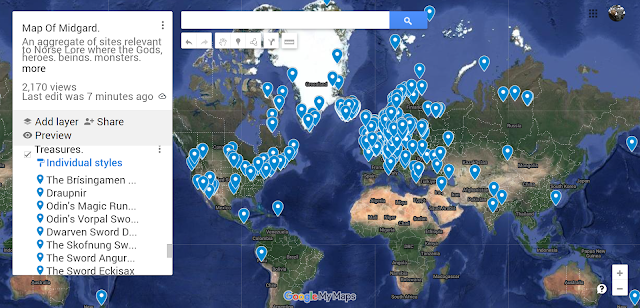
Guillermo Maytorena IV knew there was something special in the Norse Lore when he picked up a copy of the d'Aulaires' Norse Gods and Giants at age seven. Since then he's been fascinated by the truthful potency of Norse Mythology, passionately read & studied, embraced Ásatrú, launched the Map of Midgard project, and spearheaded the neologism/brand NorsePlay. If you have employment/opportunities in investigative mythology, field research, or product development to offer, do contact him.


Comments
Post a Comment